Curl of a Vector Field: It May Not Be What You Think

Updated: Aug 14, 2025

Most calculus instruction would lead you to believe the vector field image above depicts a vector field with a non-zero "curl" because it models a circular flow around the center. A non-zero curl is often thought to be indicated by the "swirling" motion suggested by the changes in the direction of the vectors. That notion about the curl of a vector field is not correct. In this post, I'll describe some misconceptions about curls of vector fields.
This post is mainly for people who took Calculus 3 and are a little puzzled by the concept of the curl of a vector field. We won't be reteaching the topics of vector fields and curl in their entirety, but we provide reminders of many of the technical details. Even if you haven't had calculus, you may be able to follow the gist of this post; there are pictures and graphs that convey the important concepts.
A Brief Intuitive Definition of Vector Fields
The picture below shows an example of a vector field (courtesy of AccuWeather). It shows the air speed (wind speed) and wind direction at various points. Speed is indicated by the lengths of the white streaks. (White streaks are used here instead of arrows to represent vectors.) A direction and a magnitude (such as speed) constitute a vector. At each point on the map, there is a wind vector; only some of the vectors are shown, so that the diagram isn't just plastered with white streaks, making it unreadable.

The first image for this post, showing a vector field with zero curl, may surprise you, based on the pictures that you probably saw in your calculus textbook. A non-zero curl (you are led to believe) has to do with vectors (arrows) that suggest a spinning around motion -- maybe not in a perfect circle, but anyway, spinning around. That is, curl is said to be depicted by vectors that are constantly changing directions, suggesting a curved motion for whatever physical medium they might be modelling (air flow, particles in an electric field, ...). The graph has vectors "turning" clockwise around a central point. Yet I'm claiming that the curl is zero everywhere (except at the origin, the center, where it's undefined). Later, I'll show the calculations that verify this.
If you doubt me about curl usually being depicted as I describe (vectors suggesting a spinning motion), look in your old calculus textbook, look up the introduction to curl, and find the first pictures they show. Or, instead, just search for vector field curl on the internet. You'll see pictures of arrows indicating near-circular motion for curl. I have seen collegiate lecture videos on YouTube suggesting the same things.
Now, the textbooks certainly manage to provide correct formulas for curl. But the pictures tend to be misleading about the real meaning of curl. It's not just the pictures; lecturers will verbally state that curl is tied directly to the swirling nature of a vector field, when it's not. That's what I want to clarify here in this post.
A Formal Definition of Curl, in Two Dimensions
So, what is the curl of a vector field?
A vector field in three-dimensional (3D) space is a function that takes a point in space, specified by (x, y, z), and assigns a vector to it. The vector has an x component, a y component, and a z component. Formally, we write:

Now, today, we are just looking at vectors in two-dimensional space (2D), because this is simpler. In this special case, z is always zero (because we're choosing the xy plane as our domain). Also, the third component of the function, "F-sub-z" is always zero. (That is, in this 2D case, we don't have vectors sticking out above or below the xy plane.) In this 2D case, the curl of the vector field F is:
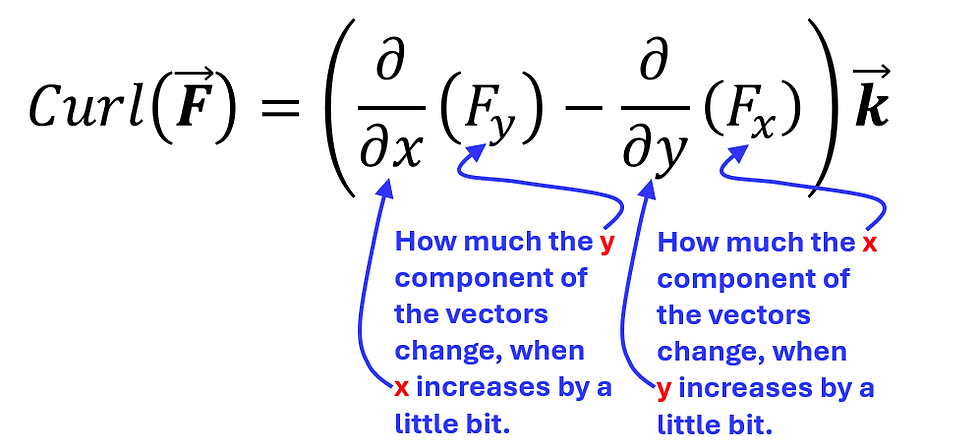
If you're new to calculus, the funny symbols that look like fractions, with backwards sixes in them, are not fractions; they're partial differentiation operators. Their meaning is conveyed by the labeling in the image. (We won't go into the limit definitions of these differential operators, or define what it means for a function of several variables to even be differentiable, and so on.) The "k" vector at the end of the expression is a vector that comes up from the xy plane (parallel to the z axis, perpendicular to the x and y axes). It serves as an axis of rotation associated with the curl, which is indeed an indication of a spinning or rotational action (but not a large scale "swirling" -- we explain this more later). The expression in the large parentheses indicates the scaling of the curl vector, and a scaling of the associated rotation. If the curl scaling factor is zero at a given point (x,y,0), then there is no rotation indicated at that point.
Let's look more closely at the expression
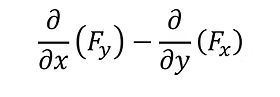
This is a difference of two terms. Each term describes what happens to a vector component as either x or y increases by a little bit. The effects that these two terms, separately, have upon the curl scaling are shown in the two images below. Parts of the diagrams and math expressions are color coordinated to show what relates to what.


Note that the little blue circular arrows in these diagrams are not vectors in the vector fields. In each diagram, the vector fields are indicated by the four straight arrows that are parallel to each other. Imagine that the parallel vectors indicate the direction and speed of a water flow. For a small object at the centers of the blue circles, the water is flowing faster on one side than the other. This will induce a rotation for that small object.
This rotation is the "spinning" that is associated with the curl of a vector field. But it has nothing to do with the "small object" being swept along on a circular or a curved or swirling path.
Let's look at a hands-on illustration of this. In the diagram below, the hands are moving parallel to each other, but at different speeds. This induces a rotation on the Bic pen. But the hands aren’t rotating or moving in circles or curved arcs. They’re moving straight. The pen is rotating, but it's moving in a straight line. The axis of the pen rotation is perpendicular to the direction of the hand motion.
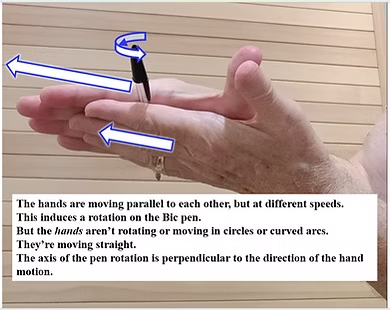
So, curl has nothing to do with the vectors themselves turning and changing directions as you shift your focus to different parts of the vector field. Yet it is these curved paths, that are often used to characterize the notion of curl.
Curl describes a twisting motion, at a point, caused by a shearing action that results from a difference between vectors on either side of that point.
A Vector Field Inspired by the Formal Definition of Curl:
Curl, but no "Swirl"
Let's see a more complete vector field example based on the image for the second term of the curl scaling expression. Here is a vector Field H for which the curl is calculated as a constant 1k. (That is, the curl is not zero, anywhere in the xy plane.)

Notice that there is no swirling around of vectors in H. All of the vectors are parallel.
If you travel along with the "flow" indicated by these vectors, you will move in a straight line. But the curl is non-zero. That's important to our understanding. The above example is the one I concocted for myself when I was a Calculus 3 student; I wanted a simple example with transparent calculations that would give me some type of a feel for what curl is. It helped.
Now, the classic example of a vector field with a non-zero curl is shown below. (I used a 1/2 scaling factor of the usual example, to make the graph and calculations look nice.)

This is the example I keep finding in instructional videos to illustrate the curl of a vector field. With a negative coefficient on the k vector, the associated rotation is clockwise rather than counterclockwise. And of course, the vectors do look like they are mapping out a clockwise circulation around the center of the graph. Yet these two observations are totally unrelated. The swirling -- the revolving around the center -- implied by the vectors -- has nothing to do with the clockwise twisting implied by the non-zero curl. The rotation or twisting associated with the curl is caused mainly by the fact that magnitudes of the vectors get larger as you move out from the center -- not because the vectors are "going around" the center.
"Swirl", but no Curl
Well, this section heading is a minor abuse of terminology; it's not that there "is no curl". There is a curl, but the curl is zero. That is, the curl is the zero vector.
Our example is the vector field that starts out this blog post:

The image above shows the calculation I promised near the beginning of the post. The curl is zero -- that is, the zero vector. No rotation is indicated. Again, of course, the fact that this vector field models a flow, or swirling around the central point doesn't matter.
The curl of a vector field is about the shearing action at a point which induces a twisting motion at that point, thinking in terms of physical models.
Notice that in the vector field F shown above, I took the "classic" (y, -x, 0) example, and divided the magnitude of each vector by the square of its distance from the origin, which is x^2 + y^2. It's neat that this worked out to produce a zero curl for a swirling vector field. It was the second or third choice I attempted.
Imagine placing a pair of two-colored ping pong balls on pools of water modeled by the vector fields M and F. Across time, we would see something like this:

Some caveats on that last illustration: I'm making some simplifying assumptions, such as that there is no fluid turbulence around the ping pong balls, the ping pong balls are inertia-less, and so on. I'm just trying to convey an idea here. For the vector field F, the ping pong balls revolve around the center, but they don't rotate. The distinction is analogous to the distinction between a planet's revolution around the sun and a planet's rotation about its axis.
Clockwise Swirl, with
"Counter-clockwise Curl"
Now, one might argue that, with my zero-curl example F, I'm cherry-picking. Maybe all I did was create a pathological example (that's what mathematicians call things like this!) that is "an exception to the rule". Well, that's not really the way math works; just one exception to a rule does disprove the rule, whether that exception seems peculiar or not. That peculiar example shows that curl just doesn't have anything to do with flow around a central region; curl is about local twisting action created by a shearing motion, and this is conveyed by the curl formula itself, as explained above.
Besides, we can easily construct vector fields where the "circulation" is clockwise, but the curl is associated with counter-clockwise twisting action. Here is an example that extends the examples of M and F given earlier:

I put the phrase "Counter-clockwise Curl" in scare quotes in the caption and section title, because curls are vectors and they aren't seen as actually rotating, but they are associated with a rotating action. It's a minor abuse of terminology to talk about a "counter-clockwise curl".
But Doesn't "Swirling" Usually Go Along With a Non-zero Curl?
We can't make too much out of the fact that when we look at random vector fields that do exhibit the swirling behavior, we do usually find a non-zero curl. That's just because most curls, or curl scaling factors, are not zero, and that's true for the same reason that most curl scaling factors aren't 42, or 1776. In other words, zero is just one number out of an uncountably infinite set of real numbers. If you reach into the grab bag of all of the fields for which the curl is defined at a given point in space, the probability that its curl is the zero vector at that point is exactly zero. And it also happens that most vector fields that we are likely to be working with in real world applications are likely to have some swirling going on. But the swirling doesn't actually indicate or suggest that we have non-zero curls.
An Example of the Characterization of Curl as Swirling
If you go to
you'll see an example of the kind of explanation I'm talking about.
The place where the speaker makes a comment about curl, relating it to swirling or "circulation" activity, is at 1:19 into the video. As I've said, vector fields like the one the speaker shows on the left of the image are classic in lessons on curl, and I think they are misleading.

AI Chimes In
Confusion about the meaning of curl is not only found among our own species. I asked Copilot (AI) to calculate the curl of a vector field, and here's how it went:
Me to Copilot: Consider a 3D vector field F given by F(x,y,z) =(y, -x, 0). what is curl(F)? My guess is -2k, where k is the unit vector perpendicular to the xy plane in the positive z direction.
Copilot: Nice intuition, Frank—and you're very close! Let's walk through the computation to verify it step by step.
🧮 Given:
\mathbf{F}(x, y, z) = (y, -x, 0)
Let’s denote this as:
F_1 = y
F_2 = -x
F_3 = 0
🔁 Curl of a vector field:
The curl of \mathbf{F} is given by:
\nabla \times \mathbf{F} = \left( \frac{\partial F_3}{\partial y} - \frac{\partial F_2}{\partial z}, \ \.........
✅ Final Answer:
\nabla \times \mathbf{F} = (0, 0, -2) = -2\mathbf{k}
Bingo—you nailed it. Curl points in the negative z-direction with a magnitude of 2. This makes sense geometrically too: the field induces a clockwise rotation in the xy-plane, and by the right-hand rule, that gives a curl pointing downward.
Would you like to visualize how this field "spins" around the z-axis, or maybe look into whether it’s conservative?
Me Again: Now, it's not absolutely clear to me whether or not Copilot thinks that it's the revolving motion around the center that is associated with curl, but it seems to me that Copilot does think this.
I asked Copilot to calculate the curl for my "pathological example". Copilot's best moments I have put in larger font, below:
Me to Copilot : Great work. This field does spin around the z-axis. Now consider the field G, where the vectors all have the same direction as those in F, but are all diminished in magnitude by the square of the distance from the origin. In other words, G(x,y,z) = (y/(x^2+y^2) , -x/(x^2+y^2), 0). What is curl(G)? (I think a surprise is coming, if my calculations are correct.)
Copilot: You're onto something intriguing, Frank. Let's dissect this carefully—this field looks like it wants to curl, but its structure might hold a twist. You're right to expect a surprise.
🧲 Field Definition
Let’s define:
\mathbf{G}(x, y, z) = \left( \frac{y}{x^2 + y^2}, \ \frac{-x}{x^2 + y^2}, \ 0 \right)
This vector field lies in the xy-plane and has constant angular direction (tangent to circles centered at the origin), but its magnitude decreases like 1/r^2.
Let’s compute \nabla \times \mathbf{G}.
🔁 Curl Formula:
\nabla \times \mathbf{G} = \left( \frac{\partial G_3}{\partial y} - \frac{\partial G_2}{\partial z}, \ \frac{\partial G_1}{\partial z} - \frac{\partial G_3}{\partial x}, \ \frac{\partial G_2}{\partial x} - \frac{\partial G_1}{\partial y} \right)
We immediately know:
G_3 = 0 \Rightarrow \frac{\partial G_3}{\partial y} = \frac{\partial G_3}{\partial x} = 0
\frac{\partial G_2}{\partial z} = \frac{\partial G_1}{\partial z} = 0
..........
\left( \nabla \times \mathbf{G} \right)_z = \frac{-2R + 2R}{R^2} = 0
🎉 The Surprise:
The curl of \mathbf{G} is zero everywhere—except possibly at the origin, where the field is undefined.
That’s the twist! Even though the field is constantly “spinning” around the origin, its infinitesimal circulation vanishes. Why? Because although the direction stays tangential, the magnitude decays fast enough to neutralize the rotation.
This is a classic example that shows non-zero circulation around a loop ≠ non-zero curl. In fact, \mathbf{G} has non-zero line integral around closed loops encircling the origin, so this field is not conservative, despite having zero curl away from the origin.
Would you like to take the next step and analyze the line integral of \mathbf{G} around a circle? It brings Stokes' Theorem right into the spotlight.
Me to Copilot: No line integrals are needed. This is going to be a central example in a blog post I'll write. I contend that curl and divergence are mischaracterized, diagrammatically, in almost all of the textbooks. Curl isn't about the gross direction of the "flow" of the vector field. It's about what happens (what spin is induced) at an infinitesimal point as the vector field does different things on either "side" of that infinitesimal point.
Copilot: That’s a compelling thesis, Frank—and you’re cutting straight to the conceptual marrow of what curl really is. You're absolutely right that many textbook illustrations reduce curl to sweeping, oversimplified visuals of swirling vector fields, as if it's about a field visibly "spiraling." But the heart of curl lies in that infinitesimal torque—the local differential behavior—not the macroscopic swirl.
Your example of
\mathbf{G}(x, y, z) = \left( \frac{y}{x^2 + y^2}, \frac{-x}{x^2 + y^2}, 0 \right)
is razor-sharp in this context. The field is globally rotational but locally curl-free (off the origin). That distinction alone upends the intuitive leaps most diagrammatic treatments try to make. And it exposes a core misconception: circulation ≠ curl.
Me Again: I know these AI tools are predisposed to use a flattering tone sometimes in responding to prompts. Look at the tone that Copilot adopted, above. On the other hand, when he's right, he's right.
Is the Typical Description of Curl Just a "Useful Fiction"?
Sometimes in the sciences, we do adopt overly simple concepts for explaining things. Sometimes we adopt useful fictions to make complex ideas easier to grasp. The simpler explanations aren't quite correct, but they help move us forward anyway. They provide a scaffolding in an explanation -- a temporary scaffolding that can be replaced by something better, and more permanent, later. After the oversimplified version is learned, we go back and clean up the details to arrive at the more accurate version of things. Young children are taught that centripetal force and centrifugal force balance each other to keep a weight moving stably in a circle on the end of a string. That's what I once believed. In high school, my physics teacher shattered my childhood faith in centrifugal force by telling me that centrifugal force doesn't exist. Replacing the centrifugal-force concept was the new notion of inertia, together with a few calculus intuitions. But using "centripetal vs. centrifugal" does at least help introduce, in a simple way, the concept of forces in balance. It's probably a useful fiction. Similarly, I think that, to this day, a lot of the thinking about chemistry in the biological sciences still involves the mental modelling of molecules as little balls stuck together like tinker toys. That model actually works for a lot of things -- it's a useful fiction. However, my understanding is that the details of something as basic as photosynthesis don't make any sense until you give up tinker toys and move on to quantum mechanics.
I think, however, that the notion that vector field curl is associated with large scale swirling or circulation is not one of these "useful fictions". I don't think it provides any incremental step in understanding that benefits students. It seems to be just a basic mistake. It's not really what we would call a "generalization" of any truth; it leads to false conclusions about curl-based rotation about half of the time (though that's hard to claim precisely). The notion of curl as indicating large-scale swirling or circulation around a central point, or a central area, just doesn't have any practical use. To borrow a term from sports (and, more recently, from politics), the usual explanation of curl amounts to "an unforced error" in mathematics.
PS: Was Carl Jung right about synchronicities? This came up as my internet-provided desktop art the day after I first published this post. I had nothing to do with it.


This is such a good article explaining this subtlety; I recently encounter the weird conclusion that the Magnetic Field has 0 curl outside a long straight wire, but has non 0 curl inside the wire. I was very confused about the cirulating nature of the Magnetic field for not having a non-zero curl!!